

Using Estidama ++ to enhance social protection

Jordan
Focus
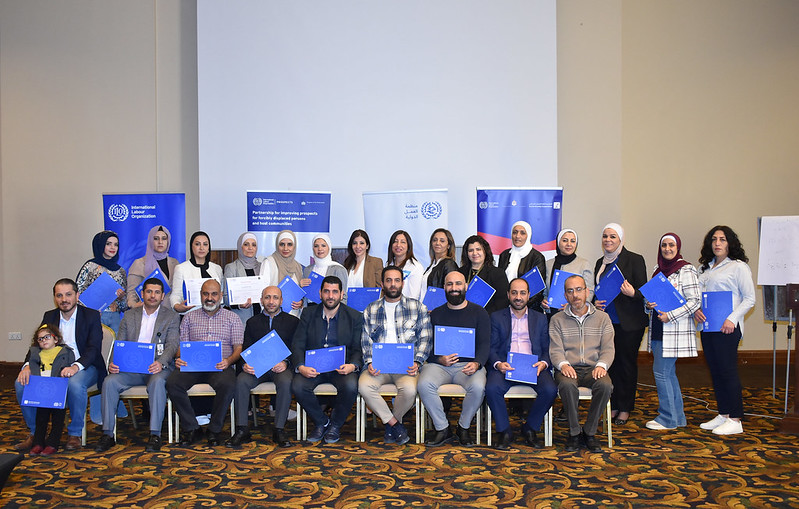
Estidama++ extended social security coverage to vulnerable workers, including refugees, women and informal-sector workers.
Estidama++ was designed to extend social security coverage to vulnerable worker groups, including refugees, women, self-employed individuals and those in informal sectors, such as agriculture and small enterprises. Administered by Jordan’s Social Security Corporation (SSC), with technical support from the ILO and initial funding from the Kingdom of the Netherlands under the PROSPECTS Opportunity Fund, the programme has registered more than 41,587 workers as of 2025, more than half of whom are non-nationals, including refugees. It introduced contribution subsidies model and tailored communication and outreach strategies to reach previously unregistered groups. Estidama++ was used by the SSC to enhance social protection and extending coverage, while addressing barriers to formalization.
Estidama++ introduced targeted social security contribution subsidies to workers and employers to address affordability barriers faced by the self-employed and waged workers with low and unstable incomes. It also introduced a child benefit pilot, which paid USD28 per child per month, as a mechanism to improve attractiveness and promote women’s engagement in social security. It also introduced a child benefit pilot, which paid USD28 per child per month, as a mechanism to improve attractiveness and promote women’s engagement in social security. The programme prioritized outreach for refugees in collaboration with UNHCR to overcome barriers like mistrust of national institutions and limited awareness of social security benefits. This included face-to-face outreach conducted with SSC representatives, the Ministry of Labour and UNHCR, including within the two largest refugee-hosting areas. Estidama++ supported the capacity building of SSC outreach officers, who engage directly with refugees and informal workers, by providing them with skills to design and deliver effective outreach sessions sensitive that are responsive to gender considerations, refuges specific needs and the challenges faced by informal workers.
A two-way chatbot was developed and piloted with SSC, allowing it to target communication to and gather information about potential and current members. In analysing data and collecting feedback throughout implementation, the programme identified areas for improvement and adjusted programme design. For example, higher attrition rates were observed among women and self-employed workers. This highlighted structural barriers that these particular groups faced, such as short-term contracts in the female-dominated education sector and irregular monthly incomes of self-employed individuals. This prompted a refinement of the subsidy design. By the end of the pilot, 87.4% of all self employed workers and 70.4% of all wage workers who had registered for social security through the Estidama++ programme had transitioned into regular social security and continued to make contributions independently of the programme’s subsidy.
As the pilot was rolled out, PROSPECTS ran a randomized control trail (RCT) to test how benefit packages and outreach impacted both social security registration and retention. It found that Estidama++ participants did not calculate the contribution subsidy value relative to their long-term benefit entitlements but instead reacted to simple cues: legitimacy conveyed by an in-person visit, clarity of immediate benefits, and reduced administrative uncertainty. While SMS campaigns reached large numbers of firms, they did not translate into meaningful increases in SSC registrations or improvements in knowledge about social protection. By contrast, in-person visits produced a 14% increase in enrolment.
The achievements of the Estidama++ programme and the way in which it addressed the gaps identified can serve as a blueprint for extending social protection to refugees and other groups of vulnerable workers. Estidama++ began as a targeted effort to use humanitarian funding for expanding social insurance coverage, focusing on contribution subsidies to incentivize formalization. However, expanding the coverage sustainably required a broader, systemic approach. Addressing challenges like affordability, relevance and financial sustainability demands solutions that integrate social protection with fiscal and employment policies, rather than relying solely on financial incentives.
Through Estidama++, the ILO was able to support the SSC in developing a long-term vision for reform. This systemic approach emphasizes addressing structural barriers and aligning social protection with Jordan’s economic modernization goals, ensuring equity and inclusivity for all workers, including those in non-traditional or informal employment. By using Estidama++ as an entry point, PROSPECTS has helped build a foundation for more comprehensive reforms that move beyond fragmented approaches to create a resilient and inclusive social protection system.
Read about Eyad Al Merjawi’s journey to obtain decent work and social protection in Jordan using Estidamaa++
Find out more about the PROSPECTS programme’s wider learning on gender and disability inclusion.
Continue reading

Case study
Extending social protection to workers in the informal economy

Kenya