

Promoting green jobs and businesses through invasive species management in Kenya

Kenya
Focus
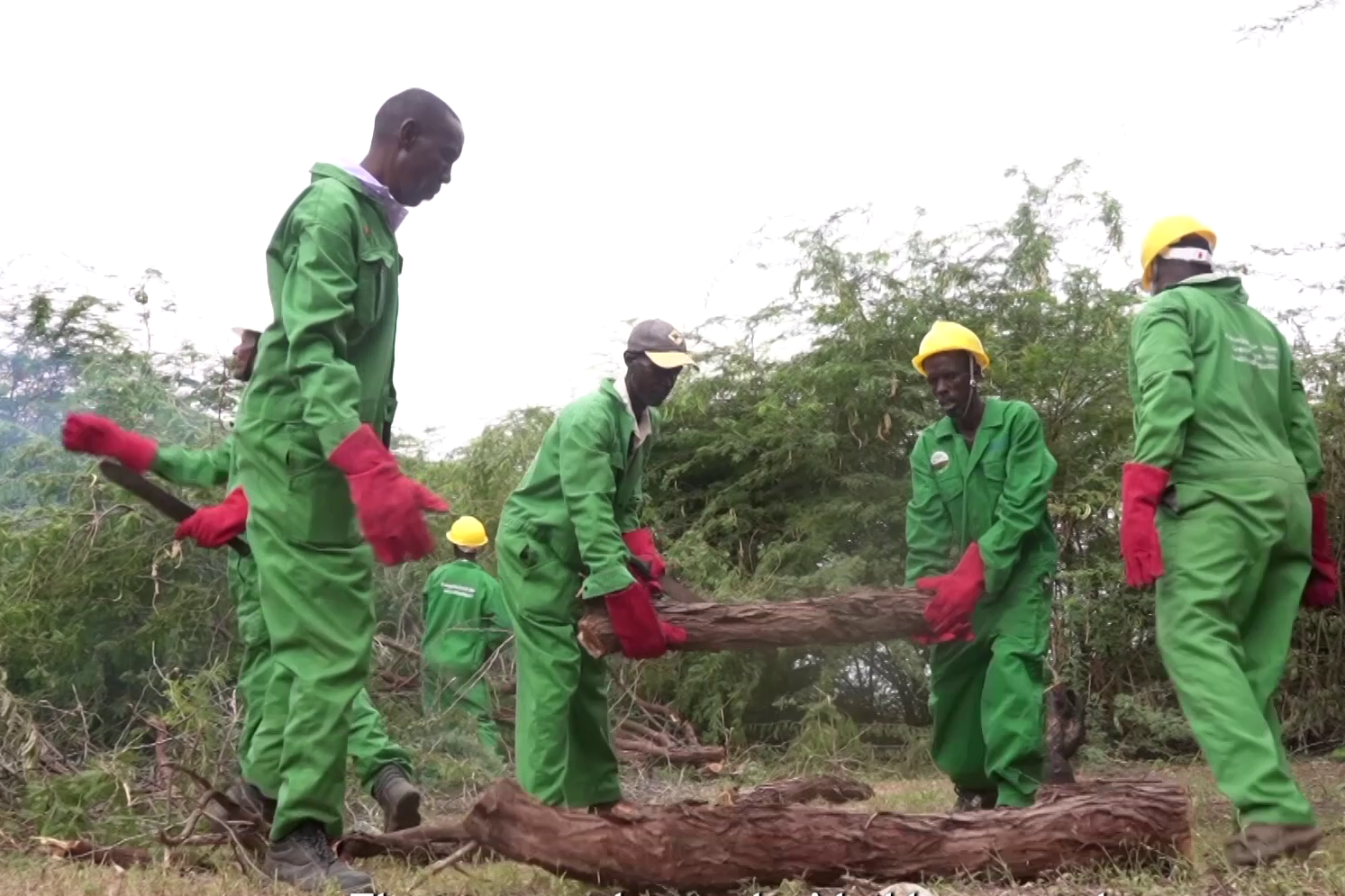
In partnership with the Kenya Forest Research Institute (KEFRI), PROSPECTS Kenya employed an EIIP approach to remove and reclaim farm and grazing land overgrown by the invasive species, Prosopis juliflora. Harvested biomass was used by local entrepreneurs to produce environmentally friendly products.
ILO’s work in Kenya began with a focus on strengthening the livestock value chain in Turkana County, a predominantly pastoralist region where livelihoods depend heavily on healthy rangelands. As part of initial assessments with local herders and producer groups, the programme identified a critical barrier to livestock productivity: vast areas of grazing land had been overtaken by Prosopis juliflora, an invasive tree species.
Originally introduced to combat desertification, Prosopis spread aggressively across arid and semi-arid lands. Its dense thickets crowd out native grasses and legumes essential for cattle, goats, and camels. The tree’s long, sharp thorns can injure livestock, while its dominance reduces biodiversity, restricts mobility for herders, and renders once-productive grazing areas unusable. For pastoral communities already facing climate stress, recurrent drought, and limited economic opportunities, the invasion further undermined livelihoods.
Recognizing that land degradation and unemployment were interconnected challenges, the PROSPECTS programme identified an opportunity to address both simultaneously. The programme adopted the ILO’s Employment-Intensive Investment Programme (EIIP) approach to remove invasive Prosopis while generating decent work opportunities for local communities, including refugees and host populations.
Implemented in partnership with the Kenya Forestry Research Institute (KEFRI) and the Turkana County Government, the intervention aligned with Kenya’s National Strategy and Action Plan for the Management and Control of Prosopis juliflora. This ensured that activities were embedded within a nationally endorsed environmental management framework and supported county-level priorities.
- Using EIIP methodologies, labour-based teams were trained and employed to:
- Clear invasive Prosopis stands from communal grazing lands
- Restore degraded areas to enable the regeneration of native pasture species
- Improve soil conditions and enhance biodiversity
- Rehabilitate land for livestock grazing and small-scale farming
Rather than treating Prosopis solely as waste, the programme embraced the national strategy’s principle of “management through utilization.” The harvested biomass became a resource for local enterprise development. Through linkages with small businesses and cooperatives, cleared Prosopis wood was processed into clean burning charcoal briquettes, animal feed products and construction poles. By linking value chain development with environmental restoration and employment-intensive approaches, the programme demonstrated that climate adaptation, ecosystem management, and job creation can be mutually reinforcing.
Continue reading

Case study
Urgent response to support refugee and host communities in Beirut

Lebanon